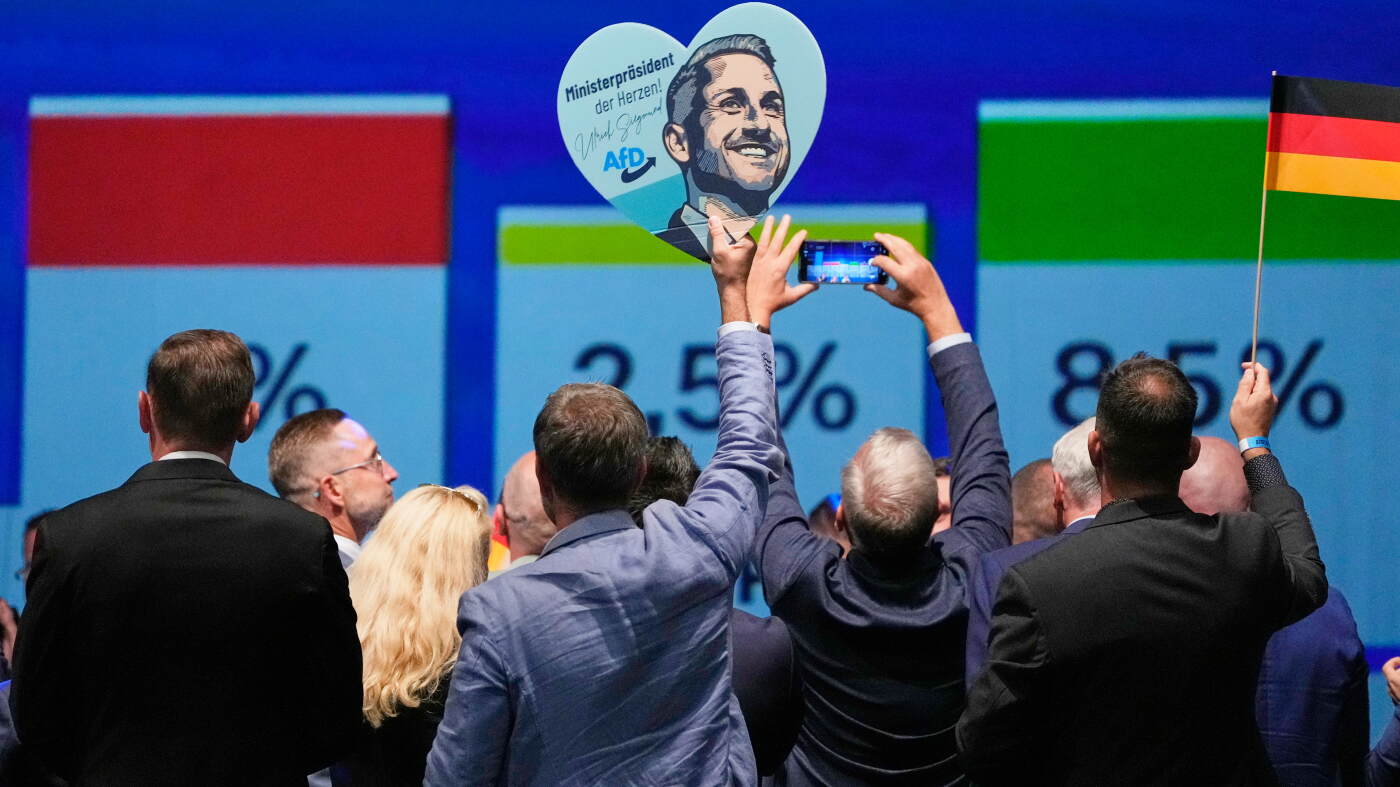
Exit polls from Sunday's Saxony-Anhalt state election project the Alternative für Deutschland (AfD) winning between 44.1% and 44.5% of the vote, a result that would more than double the party's 20.8% share from 2021 and place it far ahead of Chancellor Friedrich Merz's Christian Democratic Union (CDU) on 18.5%. If the projections from public broadcasters ARD and ZDF hold when final counts are published, the AfD would become the first party classified as right-wing extremist by domestic intelligence agencies to win a German state election since the Second World War.
The numbers behind the surge
The scale of the shift is striking. In 2021 the CDU took 37.1% in Saxony-Anhalt, enough to lead a coalition. Five years later its support has collapsed by roughly half. The AfD, meanwhile, has added more than 23 percentage points. The Federal Statistical Office of Germany will certify the final result in the coming days, but the exit polls have historically proven reliable in German regional elections. The turnout was reported as unusually high, suggesting the polarised campaign mobilised both the AfD base and opponents who failed to coalesce around a single alternative.
The AfD's federal polling has also risen steadily since the 2025 national election, where it finished second with 20.8%. Current national surveys place the party between 22% and 24%, ahead of the CDU. Sunday's result in Saxony-Anhalt, a state of 2.1 million people in the former East Germany, will be cited by both sides as evidence of whether that national trend is accelerating or plateauing.
Siegmund and the new face of the AfD
The AfD's lead candidate in Saxony-Anhalt, Ulrich Siegmund, is 35 years old and cut his teeth in marketing before entering politics. His campaign style, immaculately ironed white shirts, a permanent side parting, a smile that rarely falters, marks a deliberate departure from the shabbier image the party cultivated in its early years. On camera he speaks about mass deportations and the restructuring of public broadcasting with the same affable tone he uses to discuss education policy. That dissonance, the polished presenter advocating positions the Bundesamt für Verfassungsschutz has designated as extremist in several states, is central to the party's attempt to normalise its platform.
Siegmund's platform includes ending co-operation with the federal government on migration, revoking refugee protections for Ukrainians, and redirecting the state's public broadcaster toward what the party calls 'patriotic content'. He has also called for closer ties to Russia and to the MAGA movement in the United States. After the exit polls were released he told supporters: 'We have made history in this country. This isn't just about Saxony-Anhalt. It's a signal for the whole of Germany, a self-confident signal.'
International reactions reveal dividing lines
The international response was immediate and polarised. Donald Trump posted a screenshot of the projections on Truth Social, a gesture amplified by Kirill Dmitriev, the Russian presidential envoy for international economic co-operation, who described the result as a 'historic win'. Elon Musk congratulated the party on X; Siegmund replied thanking him for his 'support' and 'clear and highly important perspective on the political developments of our time'.
In Warsaw, Prime Minister Donald Tusk took a very different view, posting that 'in Poland, only idiots or traitors can rejoice at the triumph of the AfD in Germany.' France's Europe Minister, Benjamin Haddad, called the outcome a 'grave moment in Europe.' The split mirrors the broader geopolitical fault line: governments that see the AfD as a partner in challenging the EU's consensus on Ukraine, migration and the rule of law, versus those that view its rise as a direct threat to the European project.
What this means for Merz and the CDU
For Friedrich Merz, the result is a personal and strategic blow. He became Chancellor in 2025 promising to halt the AfD's advance by toughening migration policy and offering a conservative alternative. Instead, the CDU's vote has halved in a state it governed for three decades. Merz's strategy of rhetorical convergence, adopting harder language on deportations and border controls, appears to have legitimised the AfD's agenda without winning back its voters. Internal CDU critics have already begun questioning whether the party needs a clearer distinction from the far right rather than a blurred one.
The CDU's national polling has slipped to 26% from 28.5% at the last federal election. If the Saxony-Anhalt pattern repeats in other eastern states holding elections in 2027, Brandenburg, Thuringia and Saxony, the CDU could face a wipeout in its former strongholds. That would reshape the arithmetic of any future federal coalition, potentially forcing the CDU into an uncomfortable choice between a grand coalition with the Social Democrats or a minority government dependent on AfD toleration.
The extremist designation and democratic guardrails
The AfD is currently classified as a 'suspected extremist' organisation by the federal domestic intelligence agency, with several state branches, including Saxony-Anhalt's, designated as 'confirmed extremist'. That classification allows the agency to use surveillance tools against the party, but it does not ban it from contesting elections or entering government. A formal ban procedure would require a separate application to the Federal Constitutional Court, a high bar that has only been attempted twice in postwar history, against the Socialist Reich Party in 1952 and the Communist Party in 1956. Both succeeded. No such application has been filed against the AfD.
The other parties in Saxony-Anhalt, CDU, SPD, Greens, Linke and the FDP, have all ruled out coalition with the AfD. That 'firewall' held in Thuringia in 2024 when the AfD won the most votes but was excluded from government. Whether it holds in Magdeburg depends on whether the AfD secures an absolute majority of seats, which would allow it to govern alone, or whether the remaining parties can form a viable coalition without it. The seat projection suggests the AfD may fall just short of a majority, but the margin is tight.
Why this matters
How we got here
What happens next
The essentials
People mentioned
-
Benjamin Haddad
Organisations
Alternative für Deutschland · Christian Democratic Union · Bundesamt für Verfassungsschutz · European Union