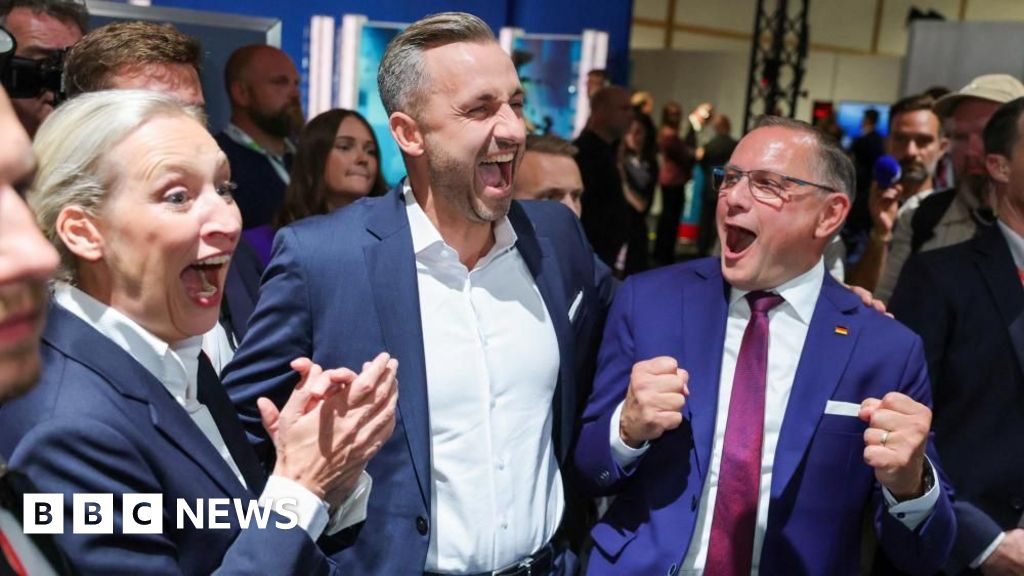
The AfD has more than doubled its vote share in Saxony-Anhalt. Exit polls from Sunday's regional election put the far-right Alternative für Deutschland at 44.5 per cent, a leap from the 20.8 per cent it recorded in the same state election in 2021. If the count confirms these figures, it is the strongest showing by a far-right party in a German state parliament election since the founding of the Federal Republic.
The centre-right CDU, which has governed Saxony-Anhalt for more than two decades, collapsed to 18.5 per cent from 37.1 per cent. Turnout hit 76.5 per cent, a record for the state of 2.1 million residents. The AfD's surge came as much from mobilising previously disengaged voters as from converting those who backed other parties.
A programme that goes beyond immigration
The AfD's "Vision 2026" programme reaches well past the border controls that dominate its national messaging. In education, the party proposes separating refugee children into their own classes and removing children with disabilities from mainstream schools. School buildings would be barred from flying rainbow flags. The curriculum would be reoriented around what the party calls "patriotic cultural policy", with daily flag-raising and national anthem singing at school events.
On migration, an AfD-led state government would establish a task force to accelerate deportations and pursue "all legal avenues" to restrict Islamic expression. The party has also pledged to challenge war refugee status for Ukrainians, arguing that as long as fighting remains concentrated in eastern Ukraine, those fleeing should seek refuge in the country's west rather than in Germany.
Public broadcasting would be dismantled. Cultural institutions would lose state funding. The party links what it terms "sexual deviations and non-reproductive lifestyles" to declining birth rates and promises to promote families consisting of a mother, father and children.
The intelligence dilemma
The AfD's Saxony-Anhalt branch is classified as a "far-right extremist" group by Germany's domestic intelligence service, the Bundesamt für Verfassungsschutz. That classification creates an uncomfortable reality: a party deemed extremist by the state's own security apparatus would, if it took control of the regional government, gain authority over domestic security policy and access to classified intelligence.
The implications extend beyond Saxony-Anhalt's borders. State governments sit in the Bundesrat, Germany's upper house, and wield significant powers over education, policing and culture. An AfD-led state would have a platform to push its agenda at federal level.
The arithmetic of exclusion
The AfD fell short of the 50 per cent needed for an absolute majority. Whether it can govern depends on how smaller parties fare against the 5 per cent threshold for parliamentary seats and whether any party is willing to break the so-called firewall, the cross-party agreement to exclude the far-right from power.
Every party in Saxony-Anhalt except the populist-left BSW has ruled out a coalition with the AfD. The BSW, led nationally by Sahra Wagenknecht, combines left-wing economics with conservative social positions and scepticism towards military support for Ukraine. Its policy overlaps with the AfD on several fronts. But even a formal AfD-BSW alliance would likely fall short of a governing majority on current projections.
Alice Weidel, the AfD's national co-leader, said after the exit poll that the party would "talk to any sensible party with whom it can find common ground on policy positions". That formulation leaves room for informal arrangements, though no party has yet indicated willingness.
Can the firewall hold?
The alternative to an AfD-led government is a coalition of mainstream parties, but the mathematics are forbidding. The Brookings Institution assessed the task of organising a CDU-led governing majority as facing "almost insurmountable difficulties". The CDU has ruled out cooperation with Die Linke, the socialist party that exit polls put at 9.4 per cent. Die Linke has indicated it would support a CDU-led government to keep the AfD out, but the CDU's leadership faces internal resistance to any arrangement with a party it considers far-left.
State premier Sven Schulze, a CDU member, congratulated the AfD on its result and acknowledged it as the strongest party in the state. That formulation itself broke with the usual firewall discipline.
A national problem for Merz
The Saxony-Anhalt result lands as a direct threat to Chancellor Friedrich Merz. Nationally, the AfD now polls at 29 per cent, making it the most popular party in Germany. Merz carries an 85 per cent dissatisfaction rating, the worst for any chancellor since the Federal Republic's founding.
Merz said before the election that he would "do everything we can to prevent Saxony-Anhalt from falling into the hands of the radicals". He has already shifted the CDU rightwards on immigration in an effort to reclaim voters. Whether that strategy works or simply legitimises the AfD's platform is a question the exit polls have made more urgent.
Lars Klingbeil, the SPD co-leader and vice-chancellor in Merz's coalition, told public broadcaster ZDF that the result was "a signal for Berlin politics" and that the government would reflect on its policies. That phrasing, from a governing party leader, concedes that voters are punishing the coalition rather than simply rewarding the opposition.
The European dimension
The AfD's pro-Russia stance adds a dimension beyond Germany's borders. Berlin has already been accused of caution on weapons deliveries to Ukraine. An emboldened AfD will press harder against military support, and its growing electoral weight makes that pressure harder for the federal government to ignore. The party's call to strip Ukrainians of war refugee status, if enacted at state level, would create friction with both Brussels and Kyiv.
People mentioned
Organisations
Alternative for Germany · Christian Democratic Union · Social Democratic Party of Germany · Free Democratic Party · Bündnis Sahra Wagenknecht · Die Linke