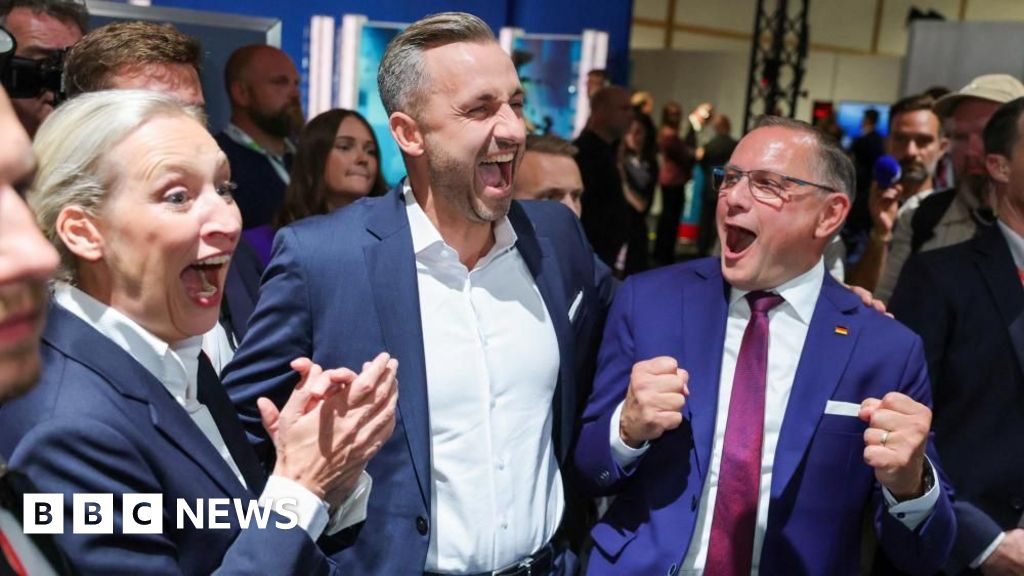
Exit polls project the Alternative for Germany at 44 per cent in Saxony-Anhalt, a result that would make it the first far-right party to win a German state election since the Second World War. The conservative CDU, which has governed the state for most of the post-reunification era, trails on 17.8 per cent. The projection, if confirmed by the final count, represents a seismic shift in a region of 2.1 million people where the AfD's state branch is already designated as right-wing extremist by the domestic intelligence service.
The arithmetic of a majority
Winning the most votes does not guarantee the AfD control of the state government. The 83-seat parliament in Magdeburg allocates seats proportionally, and the party's ability to command a majority depends on which smaller parties cross the five-per-cent threshold. The decisive variable is the BSW, a left-wing populist movement founded by Sahra Wagenknecht. If BSW fails to reach five per cent, the AfD's share of seats rises, potentially giving it an outright majority. If BSW enters, current projections put the AfD at 39 seats, short of the 42 needed to govern alone.
This threshold dynamic has turned the BSW into an unexpected kingmaker. The party has signalled a willingness to cooperate with the AfD on selected issues, a stance that breaks the informal firewall, the Brandmauer, maintained by the CDU, SPD, Greens and FDP at both state and federal levels. Should BSW clear the hurdle, the AfD would need to negotiate with a party that sits to its left on economics but shares its scepticism toward military support for Ukraine and its hard line on migration.
A firewall under pressure
The Brandmauer has held since the AfD entered the Bundestag in 2017. In Thuringia last year, the party won the state election but was frozen out of government when every other party refused to coalition with it. Saxony-Anhalt could test the firewall's durability further. The CDU's Sven Schulze conceded defeat on election night, acknowledging a campaign he described as 'extremely tough and intensive'. His federal leader, Chancellor Friedrich Merz, now faces a party that leads national polling while his own conservatives languish in second place.
Lars Klingbeil, the SPD's national co-leader and vice-chancellor in the Berlin coalition, called the result a 'signal to Berlin' and insisted the federal government would hear it. The SPD, junior partner in Merz's coalition, is polling behind both the CDU and the AfD nationally. For the Social Democrats, the eastern state results deepen a crisis of relevance in regions that once formed their industrial heartland.
Extremist label and historical echoes
The Federal Office for the Protection of the Constitution classifies the AfD in Saxony-Anhalt as a 'right-wing extremist' endeavour, a designation that permits surveillance of the party's state apparatus. Siegmund rejects the label, as does the national leadership. Critics point to the party's 'remigration' platform, widely understood to advocate mass deportations, and to figures such as Hans-Thomas Tillschneider, who keeps a Russian army mug in his office and dismisses Russia's war in Ukraine as 'not our war'. The AfD has also targeted the Bauhaus design school, which the Nazis closed in 1933, as a symbol of cultural decay.
Charlotte Knobloch, the 93-year-old Holocaust survivor who leads Munich's Jewish community, said the projection frightened her. "On days like this I find it hard to recognise my homeland any more," she said, appealing to mainstream parties not to stand by and allow "this decline". Her intervention carries particular weight in a country where the far right's electoral breakthroughs are measured against the memory of 1933.
Turnout and the mood in Magdeburg
Participation reached an estimated 78 per cent, a figure that underscores the election's salience. At the AfD's election night headquarters in Magdeburg, supporters cheered as the projection appeared, then broke into the national anthem. One voter, Ollie, described Siegmund as a leader who "gives us what no-one else can give". He added: "No matter what government, they all just promise things to get better. This is a party for the working people. It is the alternative for Germany." Such sentiment reflects a broader alienation from established parties that the AfD has successfully channelled, particularly in the former East Germany.
National implications
The AfD now leads federal polling, ahead of both the CDU and the SPD. Its strength remains concentrated in the eastern states, where economic grievances, demographic decline and a distinct political culture have created fertile ground. Yet the party's projected victory in Saxony-Anhalt, following its win in Thuringia, suggests a consolidation that could reshape the Bundestag election due by autumn 2025. Merz's government must now contend with a far-right opposition that controls a state apparatus, including police and schools, for the first time in the Federal Republic's history.
What happens next
People mentioned
-
Charlotte Knobloch
Organisations
Alternative for Germany · Christian Democratic Union · Social Democratic Party of Germany · BSW · Federal Office for the Protection of the Constitution · Jewish Community of Munich and Upper Bavaria