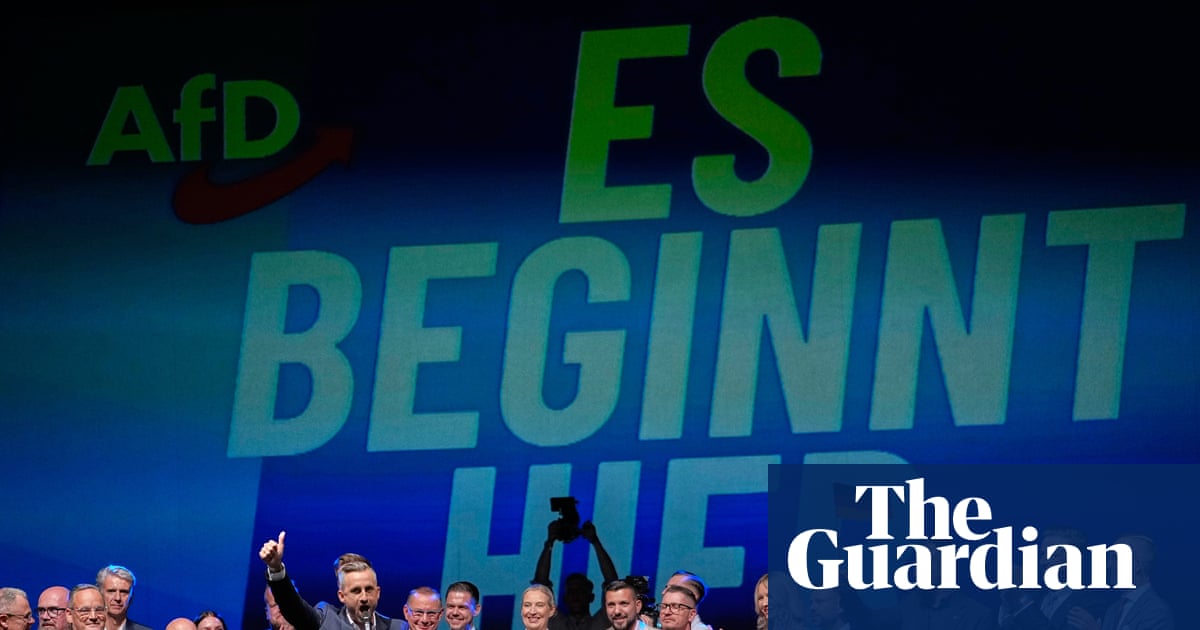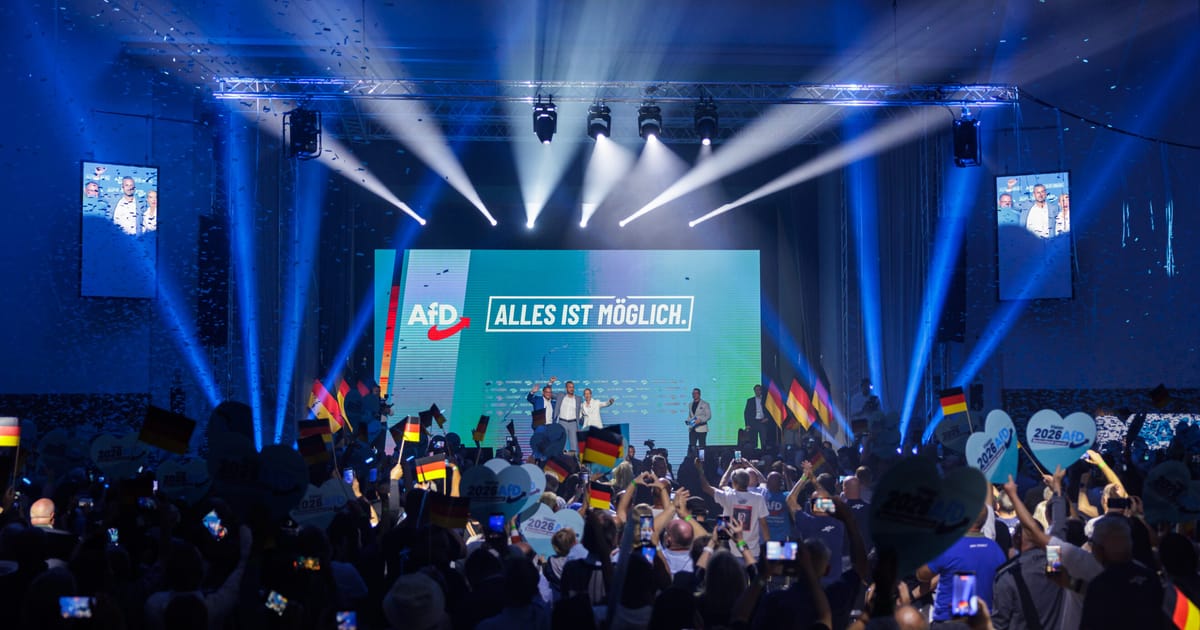
The Alternative for Germany (AfD) won 43.8 per cent of the vote in Saxony-Anhalt's state election on Sunday, more than doubling its 2021 result and sending a tremor through Warsaw. Poland's foreign minister, Radosław Sikorski, responded by warning that a far-right party gaining influence over a rearmed Germany poses a security risk to the whole of Europe.
The result is striking on its own terms. The AfD, which Germany's domestic intelligence service classifies as a right-wing extremist organisation in several states, now commands the largest share of the vote in Saxony-Anhalt by a wide margin. Chancellor Friedrich Merz's Christian Democratic Union (CDU) fell to 17.2 per cent, its worst showing in the eastern state since reunification.
For Poland, the numbers land with particular force. Warsaw has been one of the loudest advocates of German rearmament, arguing that Europe's largest economy needs to shoulder more of the continent's defence burden. But that calculus rests on an assumption: that Berlin's military power will remain under democratic control.
A record that reshapes eastern German politics
The AfD's 43.8 per cent in Saxony-Anhalt represents a dramatic acceleration. In the 2021 state election, the party took roughly 20 per cent. This time, it more than doubled that share, leaving every other party far behind. The CDU, which has governed the state for decades, was cut to less than half the AfD's result.
The pattern is not confined to one state. Across eastern Germany, the AfD has been consolidating support, capitalising on economic discontent, hostility towards immigration and scepticism about military support for Ukraine. Saxony-Anhalt, though, sets a new benchmark: the strongest result for a far-right party in a German state election since the postwar period.
Why Warsaw fears the combination
Poland's concern is not abstract. Imperial Germany occupied parts of present-day Poland during the First World War. Nazi Germany's invasion in September 1939 triggered the European war and subjected Poland to an occupation of extraordinary brutality. Those events are not distant history in Polish political consciousness; they shape how Warsaw assesses any shift in German military posture.
Sikorski made the link explicit in an interview with Handelsblatt published on Tuesday. "We want Germany to play a strong role in securing our common security under democratic leadership and as Europe's largest economy," he said. "But we remember all too well where a rearmed Germany in the hands of a far-right, pro-Russian party can lead, and that is exactly what the AfD represents."
Prime Minister Donald Tusk went further, telling reporters that "only idiots or traitors" in Poland could celebrate the AfD's triumph.
Berlin's rearmament in numbers
Germany's military spending has risen sharply under Merz. The country spent $114 billion on its military last year, nearly as much as France and Poland combined, according to NATO's defence expenditure data. Merz pledged at the start of his chancellorship in 2025 to build "the strongest conventional army in Europe."
Berlin is also planning nearly €12 billion in long-range weapons capable of striking targets hundreds or thousands of kilometres away, part of a broader effort to deter Russia as the war against Ukraine continues. The scale of that investment is precisely what makes the AfD's rise so uncomfortable for Warsaw: a Germany armed to that degree, under a government inclined to accommodate Moscow, would fundamentally alter the security picture in central Europe.
The AfD's Russia stance
The AfD's Bundestag caucus has called for Germany to halt weapons deliveries to Ukraine and to roll back sanctions on Russia as part of peace negotiations. The party's position aligns it with a softer line on Moscow at a time when most German mainstream parties, and Poland itself, have argued for sustained pressure on the Kremlin.
This is not a peripheral policy disagreement. If the AfD were ever to enter government, even as a junior coalition partner, Germany's posture towards Russia could shift decisively. For Poland, which shares a border with Russia's Kaliningrad exclave and has been among the most vocal advocates of military support for Kyiv, that possibility is alarming.
The firewall holds, for now
At the federal level, Germany's mainstream parties continue to refuse cooperation with the AfD, maintaining what is widely called the "firewall" against governing with far-right parties. The safeguard is designed to prevent a repeat of the dynamics that allowed Adolf Hitler's Nazi party to enter government and then dismantle democracy in the 1930s.
The firewall held after the Saxony-Anhalt result. No mainstream party has indicated a willingness to form a coalition with the AfD at state level. But the mathematics of German politics are shifting. As the AfD's vote share grows, the space for mainstream coalitions narrows, and the pressure to consider some form of cooperation increases.
Poland's strategic dilemma
Warsaw now faces an uncomfortable tension. Poland wants a stronger German military because it believes European security, and Polish security in particular, requires it. But a stronger German military in the hands of a party that is sceptical of NATO, sympathetic to Moscow and hostile to Ukraine would be worse, from Warsaw's perspective, than a weaker German military under democratic control.
The Saxony-Anhalt result does not mean that scenario is imminent. The AfD remains in opposition at federal level, and Germany's political system still has structural barriers against its entry into government. But the direction of travel is clear. The party that Poland fears most is the party gaining ground fastest in the country Poland most wants armed.
People mentioned
Organisations
Alternative for Germany · Christian Democratic Union · Bundeswehr