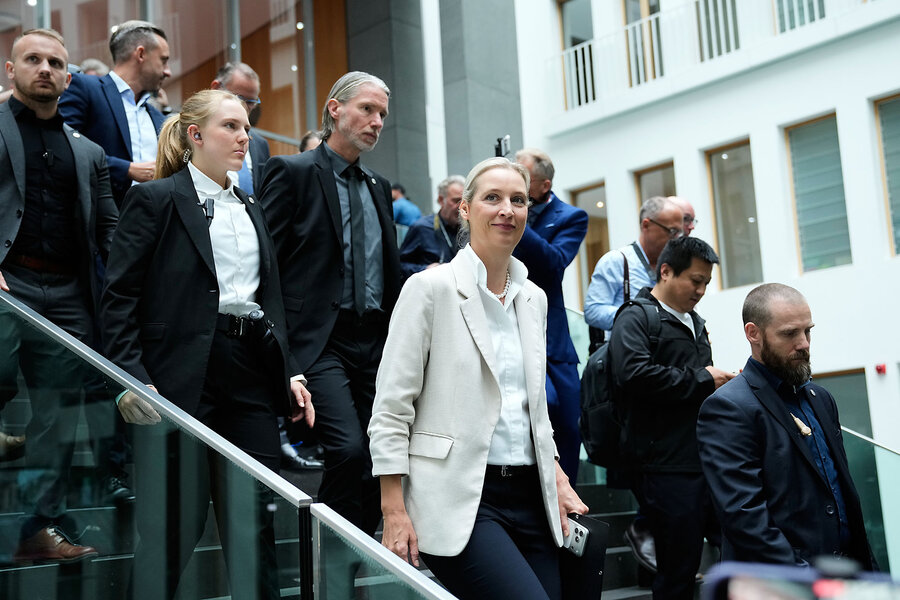
The Alternative for Germany's victory in Saxony-Anhalt on Sunday marked the first time a far-right party has won a state election in the Federal Republic's history. Chancellor Friedrich Merz called himself deeply shocked. The result was expected, the AfD has led polls in the former East German states for months, but the symbolic weight of a party that openly advocates ending support for Ukraine and restoring economic ties with Russia crossing the governing threshold at state level has concentrated minds across European capitals.
AfD's Ukraine stance goes beyond scepticism
Most European far-right parties harbour reservations about the scale and duration of aid to Kyiv. The AfD is distinct: its platform calls for a complete halt to military and financial assistance, immediate sanctions relief for Moscow, and a return to the energy and trade relationships that bound Germany to Russia before February 2022. That programme aligns almost precisely with the Kremlin's strategic objective of fracturing the European coalition that has sustained Ukraine's defence. The party's strongest electorate lies in the former East Germany, where economic grievance and historical ties to the Soviet era make its message resonant.
Kirill Dmitriev, President Vladimir Putin's special envoy for economic cooperation, did not disguise Moscow's satisfaction. He described the result as a historic win
and said the AfD was on course to restore Germany and Europe by leading the common-sense approach that migrant-friendly, warmongering, Biden-think EU politicians tried to eradicate.
The language, migrant-friendly, warmongering, Biden-think, reproduces the AfD's own rhetoric, suggesting a degree of coordination or at least close attention in Moscow to the party's messaging.
Merz holds the line but the clock is ticking
Merz's Christian Democratic Union leads the federal coalition and he has ruled out any policy shift. I will not budge one millimeter from my fundamental conviction that we must defend our freedom against Russia,
he said. The next scheduled federal election is not until 2029, giving his government institutional breathing room. But the AfD's national polling at roughly 28 percent, ahead of the Social Democrats and Greens, and closing on the CDU/CSU bloc, means the pressure will not abate. Every state election between now and 2029 becomes a referendum on the chancellor's Ukraine policy.
France: Le Pen's ambiguity on the ballot
The more immediate test arrives in France, where a presidential election takes place in spring 2027. Marine Le Pen's National Rally leads first-round polling. She has spent a decade detoxifying the party founded by her father, expelling him in 2015, and she condemned Russia's invasion in 2022. Yet her party's history is thick with Russian links: a 2014 loan from a Russian-Czech bank, frequent visits to Moscow, and a parliamentary record of opposing EU sanctions. Her current position, broad support for Kyiv but insistence that aid not be open-ended without some form of repayment
, leaves enough ambiguity for the Kremlin to hope for a shift if she reaches the Élysée.
Poland: Tusk's fragile pro-EU majority
Poland's legislative election, also due in 2027, presents a different dynamic. Donald Tusk's centrist coalition ousted the nationalist Law and Justice party in 2023, restoring Warsaw's standing in Brussels. But the Polish far right, Confederation and its allies, opposes military aid to Ukraine and has capitalised on farmer protests over grain imports and border tensions. Tusk's government has been among Kyiv's most vocal champions; a far-right breakthrough in the Sejm would complicate Poland's role as a logistics hub and political advocate.
Italy: Meloni as the unexpected anchor
The irony, as diplomats in Brussels and Kyiv privately acknowledge, is that Europe's most durable far-right leader is currently the strongest guarantor of continued support. Giorgia Meloni's government last week became the longest-serving in Italy since 1945. She has denounced the invasion, voted for every EU sanctions package, and approved successive arms deliveries to Ukraine. Her domestic credibility on immigration and sovereignty insulates her from accusations of being an EU puppet, allowing her to sustain a hawkish line on Russia without alienating her base. Zelenskyy's office watches her polling closely; if she wins re-election next year, the far-right flank of European support holds. If she falters, the gap widens.
The strategic calculus in Moscow and Kyiv
Putin's theory of the case has long rested on outlasting Western unity. He bets that domestic economic strain, migration disputes, and nationalist politics will erode the as long as it takes
consensus. The AfD result, Le Pen's polling, and the Polish far right's momentum all feed that calculation. Zelenskyy's counter-strategy depends on institutionalising aid, through the EU's Ukraine Facility, the G7 loan mechanism backed by frozen Russian assets, and bilateral security agreements, so that a change of government in one capital cannot unilaterally cut the flow. But money and munitions still require political majorities in national parliaments.
People mentioned
Organisations
Alternative for Germany (AfD) · European Union · NATO · German Federal Government · Russian Federation · Italian Government