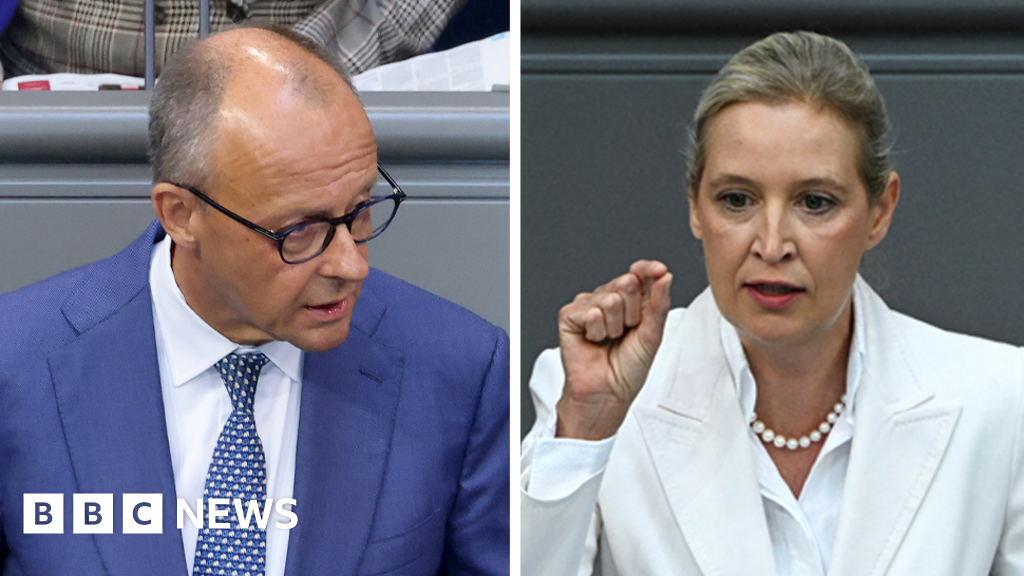
Friedrich Merz stood at the Bundestag dispatch box on Wednesday and delivered the sharpest rejection of the Alternative für Deutschland since becoming chancellor. The occasion was a government statement on the Saxony-Anhalt election, where the AfD had just secured roughly 44 percent of the vote, a result that has no precedent for a party classified as right-wing extremist by domestic intelligence in any German state since the Federal Republic was founded.
A result that rewrites the eastern map
The numbers from Sunday are stark. The AfD's 44 percent represents a near-doubling of its 2021 showing, while Merz's Christian Democrats collapsed to 17.2 percent, almost exactly half their previous share. The Social Democrats, Merz's coalition partner, slipped into single digits. For the first time since 1945, a party designated as right-wing extremist by the Federal Office for the Protection of the Constitution is the strongest force in a state legislature. Yet the AfD fell three seats short of an absolute majority, leaving it dependent on finding a partner if it wants to govern.
That arithmetic dominated the parliamentary exchange. Alice Weidel, AfD co-leader and head of its Bundestag group, opened by declaring Merz's coalition with the centre-left "pulverised" and his "time up". Merz replied that the AfD had not won a majority in Saxony-Anhalt and would not win one nationally. "You are and will remain a destructive force," he said, accusing the party of misleading voters: its premier candidate, Ulrich Siegmund, had pledged before the election to govern only with a majority, then announced within hours of the result that he would seek one.
Migration, remigration and the economic argument
The core of the confrontation was migration. Weidel claimed "daily knife violence and attacks on trains and in stations" were the fruit of mass migration. Merz countered with a statistic that has become central to his government's defence of an open labour market: one in six skilled workers in Germany now has a migration background. If the AfD's "remigration" policy, a term the party uses for mass deportation of people with foreign origins, were implemented, he said, "no single care home, hospital or restaurant could function". He added that the policy amounted to "nothing other than a synonym for ethnic cleansing in the skilled trades based on skin colour and origin".
The chancellor acknowledged that deportations of those without legal residence were necessary and that his government was accelerating them. But he drew a line between enforcement and the AfD's broader agenda, which targets people who have lived, worked and paid taxes in Germany for years. The Federal Statistical Office (Destatis) estimates that around 24 million people in Germany, roughly 29 percent of the population, have a migration background, a figure that has grown steadily since the 2015 refugee arrivals and the post-2022 influx from Ukraine.
The firewall holds, for now
Since the AfD entered the Bundestag in 2017, every mainstream party has observed a "Brandmauer", a firewall, refusing cooperation at federal and state level. That consensus is now under its most serious test. In Saxony-Anhalt, the AfD has opened talks with the Bündnis Sahra Wagenknecht (BSW), the left-populist party that won 11 percent on Sunday. A BSW-AfD coalition would be a political novelty: a far-right party governing with a far-left one, united mainly by opposition to migration, climate policy and military support for Ukraine.
Siegmund's deputy has even suggested the CDU could join such a government if it abandons the firewall. Merz ruled that out categorically on Wednesday. But the pressure is visible. In Thuringia and Saxony, where the AfD also leads polls ahead of next year's state elections, CDU state associations have struggled to form governments without either the AfD or the BSW. The federal CDU leadership insists the firewall stands; state leaders wonder how long that is sustainable when voters punish them for it.
Trump's endorsement and a postponed call
The international dimension arrived via Truth Social. Donald Trump hailed the AfD's "really big night", linking it to "absolutely horrible immigration rules and regulations". The endorsement is not the first from the US president, but it carries weight in a German debate where transatlantic relations are already strained by trade disputes and divergent approaches to Ukraine. A scheduled phone call between Trump and Merz to mark the 25th anniversary of the 9/11 attacks was postponed on Wednesday. The German government spokesman gave no reason and no new date. In Berlin, the assumption is that the White House did not want the call to appear as a reward for Merz after Trump's public embrace of his domestic opponent.
Disorder in the chamber
The session's tone was set by AfD interruptions. MPs shouted down Merz, heckled cabinet ministers and ignored repeated calls to order. At one point Julia Klöckner, the Bundestag president, warned: "We are not on a football pitch." She threatened to invoke her power to expel deputies, a step rarely taken in the post-war parliament. The disruption is a deliberate AfD tactic: to portray the Bundestag as a theatre of elite collusion and to energise a base that sees parliamentary decorum as a constraint on the popular will.
People mentioned
Organisations
Christian Democratic Union · Alternative für Deutschland · Social Democratic Party of Germany · Bündnis Sahra Wagenknecht · German Bundestag · Federal Office for the Protection of the Constitution