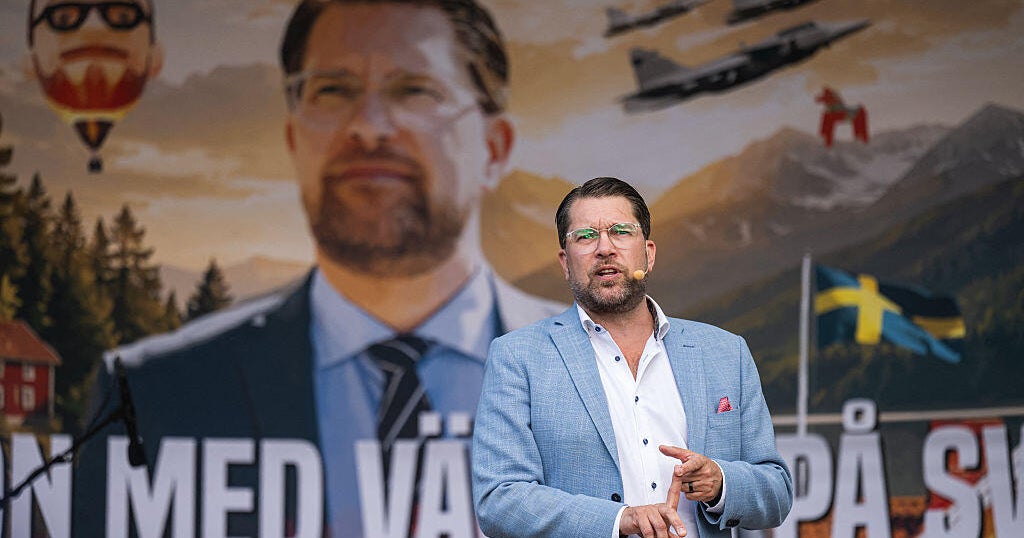
Sweden goes to the polls on Sunday in an election that will decide whether a party with roots in the neo-Nazi fringe takes a seat at the cabinet table for the first time. Prime Minister Ulf Kristersson's centre-right coalition and the centre-left bloc led by former premier Magdalena Andersson are separated by roughly three percentage points in the final public surveys, turning the vote into a referendum on the Sweden Democrats' two-decade journey from parliamentary pariah to potential governing partner.
From firewall to cabinet seats
For years Sweden's established parties maintained a strict cordon sanitaire around the Sweden Democrats, refusing any cooperation because of the party's early ties to white-supremacist movements. As recently as 2018 Kristersson assured Holocaust survivor Hédi Fried he would not work with them. The 2022 election shattered that consensus: the Sweden Democrats became the second-largest party in the Riksdag and agreed to tolerate a Kristersson minority government from the outside, wielding decisive influence over immigration and crime legislation without ministerial responsibility.
Now Kristersson has gone further, declaring that a renewed right-wing majority would include Sweden Democrats in cabinet. The pledge transforms Sunday's contest into a test of whether Swedish voters accept a party that once stood beyond the pale of democratic politics as a normal executive actor. Andreas Önnerfors, professor of intellectual history at Linnaeus University, told CBS News that the campaign has undergone a shift of focus, which has gone from the true political challenges to who is going to sit in the government.
How the 2015 crisis rewrote the political map
The realignment traces back to the 2015 European migration crisis, when Sweden received around 163,000 asylum applications, among the highest per-capita rates in Europe for a population just shy of 11 million. Integration difficulties, residential segregation and a subsequent surge in gang shootings and bombings turned immigration and crime into the defining issues of Swedish politics. The government now says asylum immigration has fallen to its lowest level since 1985, and police figures show shootings declining from 391 in 2022 to 158 in 2025, with the trend continuing this year.
Yet the political aftershocks have proved more durable than the policy outcomes. Niklas Bolin, a political scientist at Mid Sweden University, argues that Swedish politics has clearly moved in a more restrictive direction on issues such as immigration and crime, and that this shift is not limited to the parties on the right. The Social Democrats, Sweden's largest party, have also moved in this direction. Both blocs now campaign on tighter border controls, stricter citizenship requirements and expanded deportation powers, positions the Sweden Democrats pioneered.
A hybrid appeal to working-class voters
Part of the Sweden Democrats' resilience lies in a platform that blends traditional right-wing law-and-order rhetoric with welfare commitments more commonly associated with the left. Under Jimmie Åkesson, who has led the party since 2005, it has expelled extremist members, moderated its public image and added proposals such as restricting social security to citizens and demanding strict assimilation of newcomers. Önnerfors notes they have merged typical right-wing positions with typical Labour or Social Democratic positions, social security and benefits and things like that. That makes sense among ordinary people.
Who backs the Sweden Democrats
The party's electoral base is demographically distinct. Bolin describes it as particularly strong among men, working-class voters and voters outside the larger cities. This geography mirrors patterns seen elsewhere in Europe: support concentrates in smaller towns and rural areas where economic change and cultural anxiety intersect. The Sweden Democrats have also benefited from broader dissatisfaction with established parties, capturing voters who feel the traditional left and right have converged on a consensus that ignores their concerns.
NATO's newest member watches the result
Sweden's accession to NATO in March 2024 added a geopolitical dimension. The alliance values political stability and democratic norms among its members. A government that includes a party with extremist origins will be scrutinised in Brussels and Washington for its effect on coalition cohesion, particularly on issues such as support for Ukraine and Baltic Sea security. Kristersson has argued that a majority government would provide more stable decision-making than the current minority arrangement, but critics warn that cabinet representation for the Sweden Democrats could complicate Sweden's international standing.
The mainstreaming of restriction
Perhaps the most striking feature of the campaign is how little daylight separates the blocs on the issues that propelled the Sweden Democrats to prominence. Andersson's Social Democrats have endorsed tighter family reunification rules, faster deportations and a more restrictive asylum regime. The centre-right has matched them measure for measure. The debate has shifted from whether to restrict to how far and how fast. That convergence has denied voters a clear alternative on the defining issue of the past decade, leaving the choice largely about which coalition configuration they trust to implement a broadly shared agenda.
What the numbers conceal
The headline polling gap of roughly three points masks considerable volatility. Smaller parties near the 4% threshold, the Greens, the Liberals, the Christian Democrats, could tip the balance if one falls out of parliament. Turnout will matter: working-class participation has lagged in recent elections, and the Sweden Democrats' gains have come partly from mobilising non-voters. Postal and advance voting has already reached record levels, suggesting high engagement. The final result may hinge on a few thousand votes in key constituencies.
People mentioned
-
Andreas Önnerfors
-
Niklas Bolin
Organisations
Sweden Democrats · Social Democratic Party · Government of Sweden · NATO