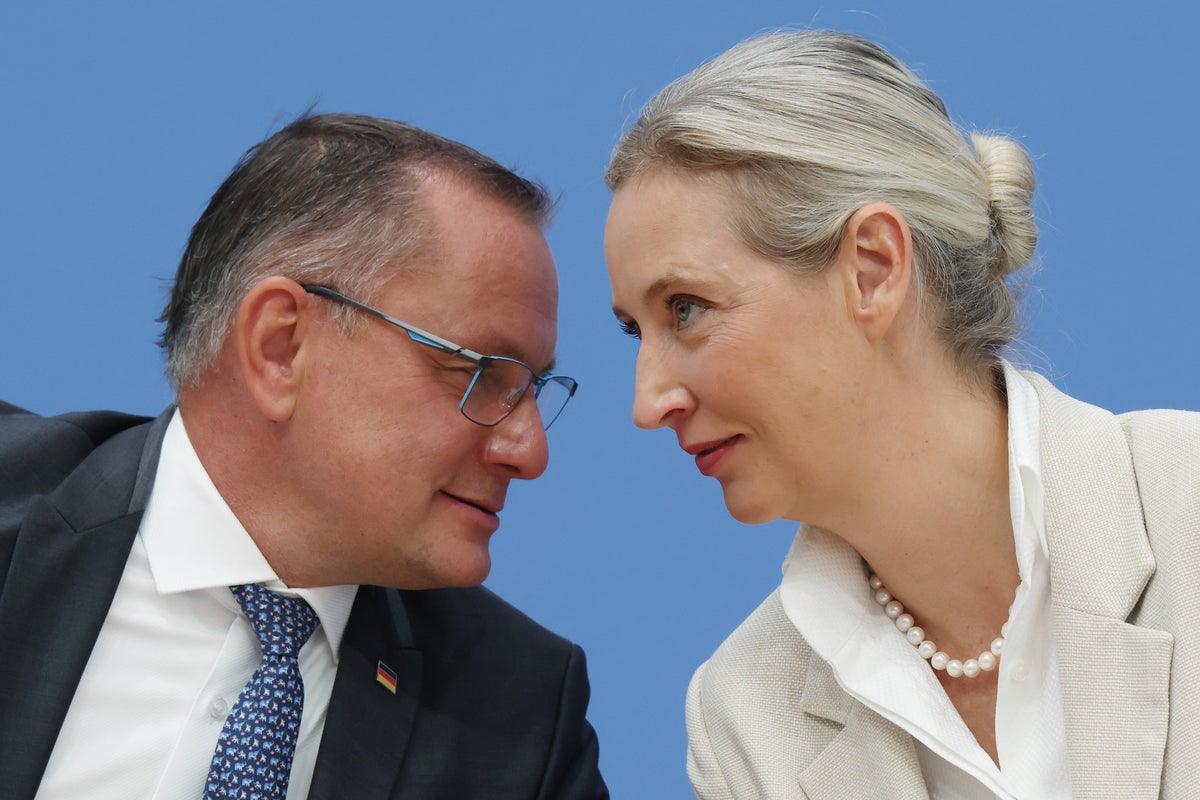
The Alternative for Germany (AfD) captured 44 per cent of the vote in Saxony-Anhalt on Sunday, more than doubling its 2021 result and delivering the strongest showing for a far-right party in a German state election since the Second World War. Turnout reached record levels. Yet the party still fell short of an absolute majority, leaving it dependent on a coalition partner that, under Germany's long-standing firewall, does not exist.
A result that breaks the postwar pattern
No far-right party has held government office in Germany since 1945. The firewall, an informal but rigid agreement among the CDU, SPD, Greens, FDP and Left Party to exclude the AfD from any coalition, has held for a decade. Sunday's result does not break it arithmetically; the AfD cannot govern alone. But it breaks the political assumption that the firewall can contain the AfD indefinitely. The party's Saxony-Anhalt branch is formally designated as a right-wing extremist organisation by the Bundesamt für Verfassungsschutz, Germany's domestic intelligence agency, citing "numerous anti-Muslim, racist and antisemitic statements". That designation makes cooperation constitutionally fraught, yet 44 per cent of voters in the state chose the AfD anyway.
Not just an eastern problem
Analysts have long treated the AfD as an eastern German phenomenon, rooted in post-reunification economic dislocation and lower immigration exposure. The data no longer support that comfort. In the 2025 federal election, the AfD ran second in constituencies across western states including Bavaria, Baden-Württemberg and North Rhine-Westphalia. Since then, almost every national poll has placed the AfD first, ahead of the CDU, the SPD and the Greens. A hypothetical coalition of Germany's three traditional governing parties would now struggle to command a Bundestag majority. The Saxony-Anhalt result is the loudest confirmation yet that the AfD's appeal has nationalised.
Merz's gamble and its consequences
Chancellor Friedrich Merz took the CDU leadership promising to win back voters who had drifted to the AfD by adopting harder positions on migration, identity and European integration. The strategy has backfired. An exit poll in Saxony-Anhalt found that 88 per cent of respondents believed better policies from Merz's federal government would have weakened the AfD in the state. Instead of draining the AfD's reservoir, the CDU's rightward shift has legitimised the vocabulary and priorities of the far right, allowing the AfD to present itself as the authentic version of what the CDU now only imitates. Some conservative voters, alienated by the CDU's drift, have moved further right rather than returning to the centre.
The arithmetic of exclusion
Germany's proportional representation system makes majority governments rare. The firewall works only while the non-AfD parties can assemble a majority without the AfD. That arithmetic is tightening. In Saxony-Anhalt, the CDU, SPD, Greens, FDP and Left Party together hold a majority, but their policy differences, on energy, migration, fiscal rules, make a stable coalition difficult. At federal level, the same fragmentation threatens. If the AfD sustains its current polling above 30 per cent nationally, the number of mathematically viable coalitions that exclude it shrinks toward zero. The firewall then becomes a choice between governing with the AfD or governing not at all.
What the numbers conceal
Vote share alone does not capture the AfD's institutional advance. The party now holds the district administrator's office in several eastern counties, controls key committee chairs in state parliaments, and has built a professional parliamentary apparatus that rivals the established parties. Its youth wing, the Junge Alternative, is classified as extremist in multiple states. The party's funding, once opaque, now flows through the same public financing mechanisms as its rivals, scaled to its vote share. Each election that expands its share deepens its institutional entrenchment, making future exclusion harder in practice even if the firewall holds in principle.
The European dimension
Germany's partners are watching. The AfD's platform includes withdrawal from the euro, a referendum on EU membership, and an end to sanctions on Russia. A German government that included the AfD, or a German parliament paralysed by the firewall's arithmetic, would alter the EU's centre of gravity. The European Commission, the European Central Bank and NATO all operate on the assumption of a predictable German anchor. That assumption is now contested. The Saxony-Anhalt election was a state vote; its consequences are continental.
No easy exit
The SPD and Greens argue that social investment and climate policy address the grievances that feed the AfD. The CDU insists that only stricter migration control and cultural conservatism can win back voters. Both diagnoses cannot be right; both may be wrong. The AfD's rise correlates with stagnant real wages, a housing shortage, and a perception, strongest in the east but spreading west, that the political class manages decline rather than reversing it. No party has yet offered a narrative that connects economic renewal with democratic renewal. Until one does, the AfD's floor rises with each election.
People mentioned
-
Matt Fitzpatrick
Organisations
Alternative for Germany · Christian Democratic Union · Social Democratic Party · Greens · Bundesamt für Verfassungsschutz