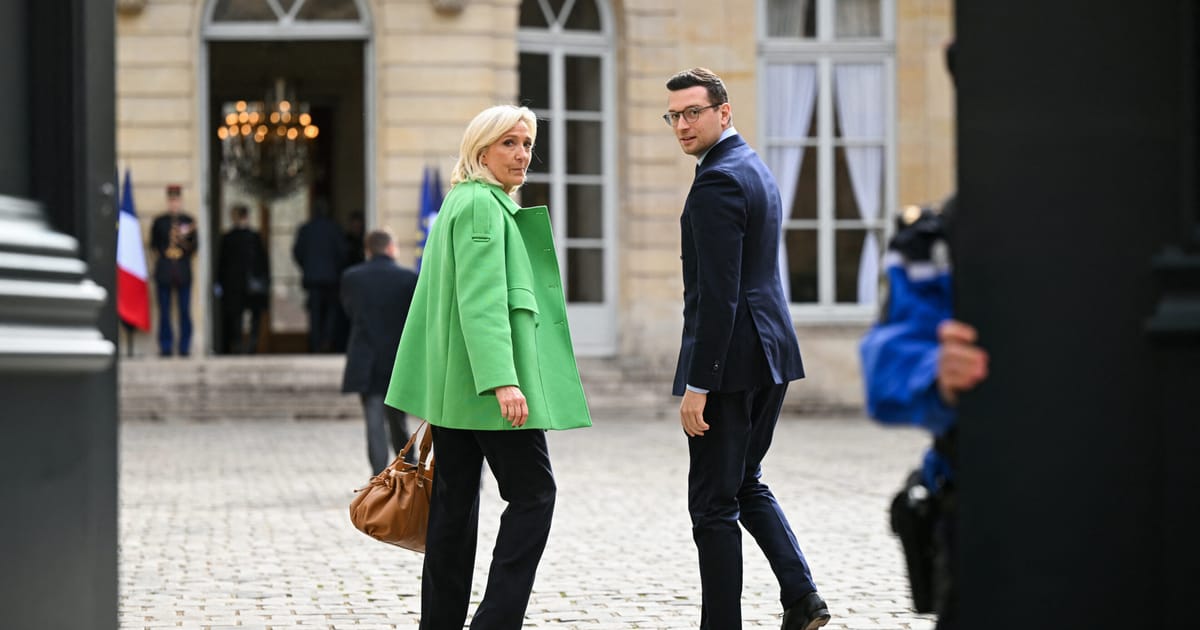
Jordan Bardella spent months preparing to lead France's National Rally into the 2027 presidential election. Then a court ruling in early July shortened Marine Le Pen's sentence for misusing European Parliament funds, clearing her to run for office again. Within days, the 30-year-old had to step aside and let his mentor reclaim the candidacy she has held for more than a decade. The transition has been anything but smooth.
In the weeks since, the two leaders of France's far-right party have struck competing notes on pensions, the public wearing of hijabs and the departure of a senior economic adviser. National Rally officials insist the disagreements are routine internal debate. The evidence on display suggests something more awkward: a party whose two most prominent figures have not yet settled what they stand for, or who decides.
A court ruling reshuffles the ticket
Le Pen has been the face of French far-right presidential politics since 2012. She reached the second-round runoff in both 2017 and 2022, losing each time to Emmanuel Macron. When she was convicted of embezzling EU parliamentary funds, the initial sentence included a ban on holding public office, which would have barred her from running in 2027. Bardella, who became party president in 2022 and has served as a member of the European Parliament, began positioning himself as the natural successor.
The court's decision to shorten that sentence changed everything. Le Pen could run again, and she intended to. The day after the ruling, Bardella stood beside her, visibly stiff, as she announced that she would be the candidate and he would be her pick for prime minister, a considerably less powerful role under France's semi-presidential system. The choreography was meant to signal continuity. It signalled something closer to a demotion.
Bardella had spent his months as presumptive candidate trying to soften the party's image, particularly on the economy. He positioned himself as fiscally responsible, a leader who could appeal to moderate voters the National Rally would need to win a national contest. Those efforts now clash with Le Pen's long-standing policy instincts, and the friction is showing.
Pensions and the price of fiscal discipline
Macron's pension reform, which raised the legal retirement age from 62 to 64, was one of the most bitterly contested measures of his presidency. It sparked months of strikes and protests in 2023. Le Pen has promised to reverse it, allowing workers to retire at 62 once more. It is a popular pledge in a country where the reform remains widely disliked, and it aligns with her long record of opposing benefit cuts.
Bardella, by contrast, had openly questioned the policy earlier this year, as part of his effort to cast himself as a responsible steward of public finances. Rolling back the pension reform costs money, and the National Rally has not yet explained where it will come from. Le Pen has promised to present a plan this autumn to cut roughly €125 billion in spending, but the details remain unpublished. Alexandre Loubet, a National Rally member of Parliament, acknowledged at an agricultural fair on Saturday that the party was still working out the numbers.
Bardella did not attend a presidential debate last week at which Le Pen doubled down on the pension rollback. His absence was conspicuous. It is the central fiscal commitment of her campaign, and the man she says will be her prime minister was not there to defend it.
One adviser, two explanations
The same debate brought news that François Durvye, one of Le Pen's key economic advisers and a leading advocate of fiscal discipline within the party, was leaving. Durvye, a former financier, had reportedly pushed Bardella to rebel and run instead of Le Pen. He also made clear, both privately and publicly, that he could not defend the party's economic positions.
The explanations for his departure diverged immediately. Le Pen, speaking on the sidelines of the debate, said it had been "her wish." Bardella, pressed by reporters at a campaign event, described it as Durvye's "personal decision." Those are not the same thing. Either the candidate pushed out an adviser who disagreed with her, or the adviser left of his own accord because he found the platform indefensible. The party's two most senior figures offered contradictory accounts within hours of each other.
The hijab ban and the referendum
Le Pen has for years proposed banning the hijab in public spaces. It is one of her most recognisable policy commitments and a reliable way to signal to the party's base that she has not moderated on identity and immigration. This week, Jean-Philippe Tanguy, a National Rally MP and one of Le Pen's top lieutenants, said that wearing the hijab in public would become a fineable offence if she took office.
The following day, Bardella appeared to downplay the proposal. Rather than confirming a ban, he said the question would be put to French voters via a referendum. Le Pen later said the referendum would include a series of measures designed to "fight Islamist ideology." The gap between a criminal penalty and a consultative vote is wide. Laurent Jacobelli, a National Rally MP and spokesperson, insisted there was no tension: "There was an internal debate, and the conclusion was the proposed hijab ban. It was settled with everyone's agreement, Jordan included." He added that the debate had been about "the how," not the ban itself.
Rival parties and constitutional scholars have argued that a public ban on religious headwear would violate France's constitutional protections. Bardella's referendum suggestion may reflect genuine disagreement, or it may be a tactical manoeuvre to give an unpopular measure democratic cover. Either way, the optics of two leaders contradicting each other within 24 hours on a flagship policy are damaging.
Insisting there is nothing to see
National Rally officials have worked to contain the damage. Jacobelli's insistence that the hijab ban was agreed by everyone, including Bardella, is the party line: internal debate happened, conclusions were reached, unity prevails. Loubet, speaking at the agricultural fair where Bardella appeared on Saturday, cast the 30-year-old as Le Pen's first line of support, broadening the future parliamentary majority "in the media, on the field."
Bardella himself batted down reporters' questions about the disagreements. "I will campaign whatever happens," he said. "Alleged hurt feelings don't matter." The word "alleged" does a lot of work in that sentence. He did not deny the disagreements. He dismissed their relevance.
The problem for the National Rally is that the disagreements are not alleged; they are documented. On pensions, on the hijab ban, on why an economic adviser left, the two leaders have said different things within days of each other. The party can insist that this is normal internal debate, but the pattern is unmistakable. Bardella spent months moving the party towards a more moderate economic posture. Le Pen, resuming command, has reverted to positions that have defined her career.
What the supporters think
Not everyone in the party's base is persuaded that Le Pen's return to the top of the ticket is the right outcome. At the agricultural fair, Kaelig Le Bris, a 41-year-old garbage collector who had come to see Bardella, was blunt. "Bardella would have been a better candidate," he said. He described himself as a fan of Le Pen but added: "A guy like him at the helm of the country, that would have been something."
The sentiment captures a genuine tension within the National Rally's electorate. Le Pen is the most recognised figure in French far-right politics and leads current polling for the first round of the 2027 election. She has twice reached the runoff and twice lost. Bardella represents a generational shift that some supporters find compelling, even if he lacks her experience and name recognition.
People mentioned
-
François Durvye
-
Jean-Philippe Tanguy
-
Alexandre Loubet
Organisations
National Rally · European Parliament