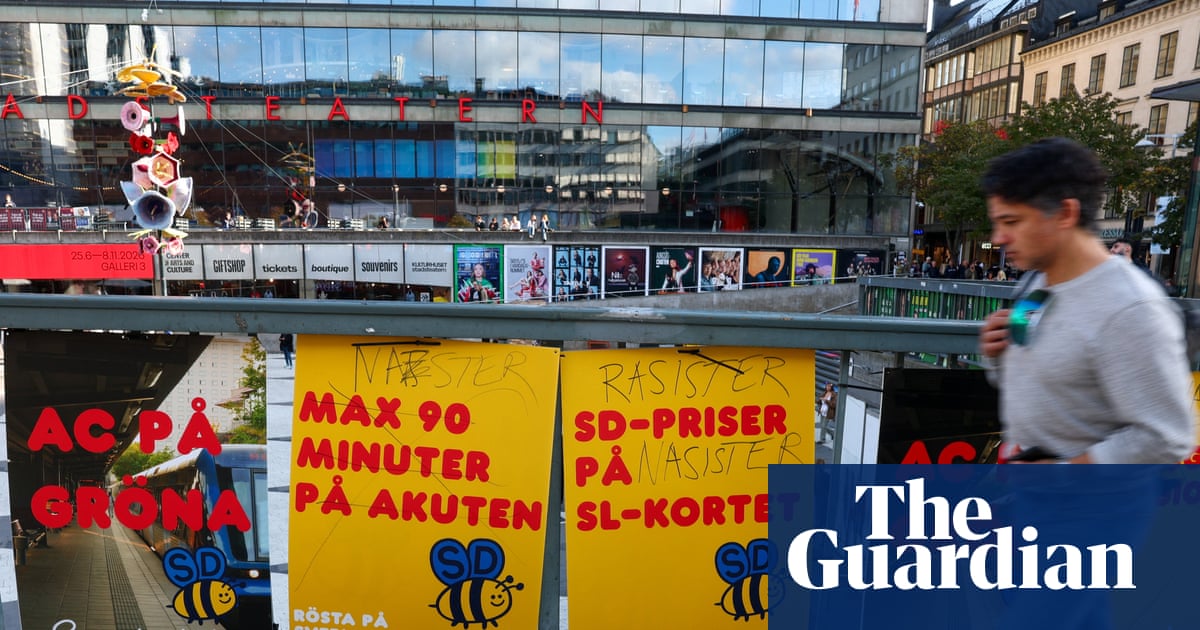
Sweden's general election on Sunday could deliver the far-right Sweden Democrats their first ministerial positions, as the right and left blocs sit separated by just 0.3 percentage points in the final polls. The Dagens Nyheter/Ipsos survey published on Friday gave Magdalena Andersson's centre-left alliance 175 seats against 174 for Ulf Kristersson's centre-right coalition, a margin so thin that small-party performance and turnout will determine who governs.
A single seat in the balance
The 0.3-point gap translates into a one-seat difference in the 349-seat Riksdag. Record early voting is expected, and several smaller parties hover near the 4% threshold needed to enter parliament. The Liberals, led by Simona Mohamsson, sit inside the governing coalition but have drawn criticism for openly aligning with Sweden Democrat leader Jimmie Åkesson in recent months. On the left, the Centre party's turnout could prove equally decisive. The Left party (Vänsterpartiet) has gained ground, particularly in Stockholm municipality, where it hopes to overtake the Moderates as the second-largest party.
Voters rank healthcare, law and order, immigration and the economy as their biggest concerns. Final television debates between party leaders were held on Friday night, but the result may not produce a quick resolution. Coalition negotiations could take weeks or even months.
The taboo that broke in 2022
Sweden's centre-right parties long refused to govern with the Sweden Democrats, treating the party as beyond the pale. That consensus collapsed after the 2022 election, when Kristersson struck a deal giving the SD influence over policy in exchange for parliamentary support. The arrangement gave the SD outsized sway over immigration and criminal justice despite holding no ministerial briefs.
Four years on, Kristersson has gone further, promising the SD actual ministerial posts if returned to power. What was once a governing taboo is now an explicit campaign promise.
What ministerial posts would mean
Fredrik Furtenbach, a senior political correspondent for Sveriges Radio, Sweden's public broadcaster, said that if the rightwing bloc wins, the SD is likely to receive several ministerial positions, which would be a "big breakthrough for them". The SD manifesto includes revoking permanent resident permits, further cutting immigration, and introducing "anti-Swedish sentiment" into legislation on incitement against ethnic groups. One of its slogans promises to "make Sweden Sweden again".
Entering government with actual portfolios would give the party direct control over policy implementation, not merely influence from outside the cabinet table. If the right loses, Furtenbach expects a post-election reckoning within centre-right parties about "whether they allowed the Sweden Democrats to get too close".
A human rights reputation under strain
Legal and civil rights experts have warned that SD's entry into government would further erode Sweden's reputation as a global advocate for human rights, a standing that has already deteriorated under the current administration. John Stauffer, legal director at Civil Rights Defenders, said: "What we have seen in the past four years is huge changes when it comes to policies on crime and immigration." He added that the concern going forward was that the government would aim "to further decrease the number of people coming to Sweden, the number of people who can get protection, and also that as many people as possible with migrant backgrounds leave Sweden, either by force or voluntarily."
Sweden has already lowered the age of criminal responsibility, deported teenagers, and sent 14-year-olds to adult prisons under the current government. Stauffer said many voters and politicians still saw Sweden as a "champion of human rights and a champion of the rules-based world order", but that the Sweden Democrats "do not have that ambition". He added: "It's a fair guess that the negative trend will continue with SD in government, the view from abroad of Sweden will continue to deteriorate, less and less will be seen as a champion of human rights, but as any other country maybe. For some time Sweden has been seen as the exception."
The left offers no reversal
Andersson's Social Democrats have not offered a straightforward undoing of the current direction. In an attempt to win back voters, the party has shifted rightward on crime, immigration and integration. Stauffer warned that a Social Democrat-led government would be unlikely to roll back the current hardline policies. "With a Social Democrats-led government, many of the things we see as problematic are not going to be rolled back," he said. "But maybe negative development will not continue in the same way."
The result is that regardless of who wins, Sweden's immigration and criminal justice regimes are likely to remain far stricter than they were before 2022. The policy distance between the two blocs on these questions has narrowed sharply.
A test of far-right appeal across Europe
Sweden's election comes days after Germany's Alternative für Deutschland finished first in key state elections, and as Marine Le Pen leads polls for next year's French presidential vote. The Swedish result will be read across Europe as another measure of how far mainstream parties have been pulled toward positions once confined to the fringe.
Bo Petersson, a political science professor at Malmö University, argued that the Sweden Democrats have already won the immigration argument among mainstream parties, leaving the election as a test of whether the party has further appeal. "The mainstream parties have taken the restrictive immigration politics and then there isn't so much for SD to say 'we are unique and stand for this'," he said. "They have been a very clear part of the establishment."
People mentioned
-
John Stauffer
-
Bo Petersson
-
Fredrik Furtenbach
Organisations
Sweden Democrats · Social Democratic Party · Moderate Party · Civil Rights Defenders · Liberals · Left Party