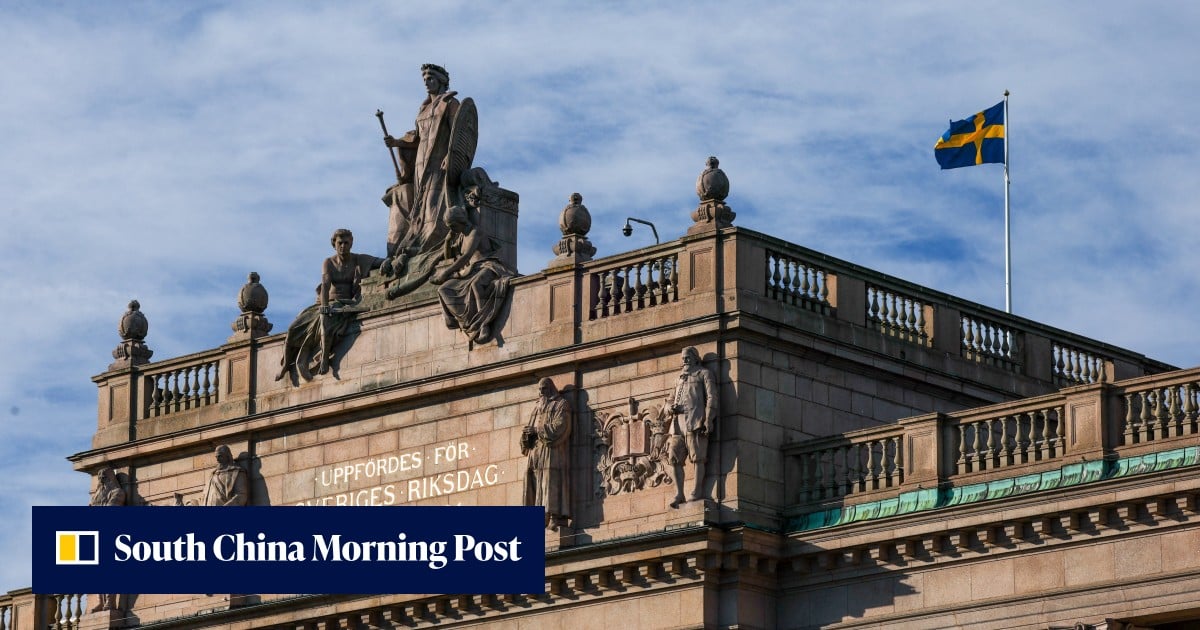
Sweden goes to the polls on Sunday in a general election that will decide whether the country's centre-right government survives or whether the far-right Sweden Democrats take a formal place in cabinet for the first time. Prime Minister Ulf Kristersson, leading a minority coalition of his Moderate Party, the Christian Democrats and the Liberals, has spent the final days of the campaign urging voters to give him a renewed mandate to "make Sweden great again", a deliberate echo of Donald Trump's slogan that underscores how far the political conversation has shifted.
The campaign's final days
For months, opinion polls gave the left-wing opposition bloc, the Social Democrats, the Left Party, the Greens and the Centre Party, a consistent lead. That advantage has evaporated in the closing week. Survey averages now show the two blocs separated by a margin within the statistical noise, turning the final weekend of campaigning into a genuine contest. Kristersson's appearances have focused on law and order, while his opponents have doubled down on household economics and the state of the welfare system.
The election takes place against a European backdrop in which right-wing governments hold power in Italy, the Netherlands, Finland and, until recently, Poland. A Swedish result that brings the Sweden Democrats into government would extend that pattern across the Nordic region, where Finland's coalition already includes the Finns Party and Denmark's government has pursued strict immigration policies with broad parliamentary support.
Crime and the right's narrative
Organised crime has dominated the political agenda for the past four years. Sweden has seen a sharp rise in shootings and bombings linked to gang networks, many connected to the drug trade. In 2023, the country recorded 363 shootings, 53 of them fatal, according to the Swedish National Council for Crime Prevention, figures that are high by European standards. The government has responded with harsher sentencing, expanded surveillance powers and a controversial proposal to strip dual nationals of citizenship for serious crimes.
Voters like Kurt Flodin, a 79-year-old pensioner encountered at a Kristersson rally, cite crime as their overriding concern. "The most important thing is that the right-wing wins, to continue what they have started," he said. The government's tough-on-crime platform resonates particularly in suburbs and smaller towns where gang violence has been most visible, though critics argue that the measures undermine legal safeguards without addressing root causes such as segregation and school failure.
The Social Democrats' welfare pitch
The Social Democrats, who governed Sweden for the better part of the 20th century and remain the country's largest single party, have built their campaign on the cost of living. Party leader Magdalena Andersson, finance minister from 2014 to 2022 and prime minister for seven months in 2021-22, has promised to cap electricity prices, increase housing allowances and inject funds into healthcare and elderly care. The party argues that eight years of centre-right or right-leaning policy have eroded the universal welfare model that underpins Swedish social cohesion.
Jenny Larsson, a theatre worker who turns 54 on election day, said these pledges matched her priorities. Healthcare queues have lengthened, municipal care for the elderly faces staffing shortages, and school results have slipped in international rankings. The opposition's argument is that tax cuts introduced by the current government have disproportionately benefited higher earners while local authorities, responsible for the bulk of welfare delivery, struggle with structural deficits.
A fragmented parliament and the Sweden Democrats
The Sweden Democrats, founded in 1988 with roots in the neo-Nazi fringe, have undergone a deliberate mainstreaming under leader Jimmie Åkesson. They became the second-largest party in the 2022 election with 20.5 percent of the vote. The Tidö Agreement, negotiated after that election, gave them policy influence over immigration, crime and energy in exchange for parliamentary support of Kristersson's minority government. They have used that leverage to push through stricter asylum rules, expanded deportation powers and a pause on new wind farms.
What happens after Sunday depends on the arithmetic. If the right bloc, Moderates, Christian Democrats, Liberals and Sweden Democrats, secures a majority, Kristersson could form a majority government with the Sweden Democrats as formal coalition partners. If the left bloc edges ahead, Andersson would need to negotiate with the Centre Party and possibly the Greens and Left Party, a combination that failed to hold together after the 2018 election. A third scenario, a hung parliament with neither bloc able to govern, would likely trigger weeks of negotiation or a snap election.
Economic backdrop
Sweden's economy has slowed sharply since the Riksbank began raising interest rates in 2022. GDP contracted by 0.3 percent in 2023, and the Eurostat forecast for 2024 shows growth of just 0.2 percent. Household debt stands at roughly 190 percent of disposable income, among the highest in Europe, making the population acutely sensitive to mortgage costs. Inflation has fallen from a peak of over 10 percent in late 2022 to around 2 percent, but real wages have yet to recover. The krona has weakened against the euro, adding to import costs.
The government points to a balanced budget and a debt-to-GDP ratio below 30 percent as evidence of fiscal discipline. The opposition counters that the room for manoeuvre exists precisely because previous Social Democrat governments built up buffers, and that current spending priorities, tax cuts for high earners, defence increases, have come at the expense of municipal services. Defence spending is set to reach 2.6 percent of GDP by 2028, driven by the security environment and NATO accession.
What the polls actually show
Polling in Sweden has been volatile. The major aggregators, Novus, Ipsos, SCB, have shown the left bloc's lead shrink from around six percentage points in spring to roughly two points in the final published surveys before the election silence period. The Sweden Democrats have hovered between 18 and 21 percent, while the Moderates have slipped from their 2022 high of 19 percent to the mid-teens. The Social Democrats have held relatively steady around 30 percent. The Centre Party, a liberal-agrarian party that has swung between blocs, could be the kingmaker if it crosses the four-percent threshold; it currently polls near that line.
People mentioned
-
Kurt Flodin
-
Jenny Larsson
Organisations
Government of Sweden · Social Democrats · Moderate Party · Sweden Democrats · European Parliament